

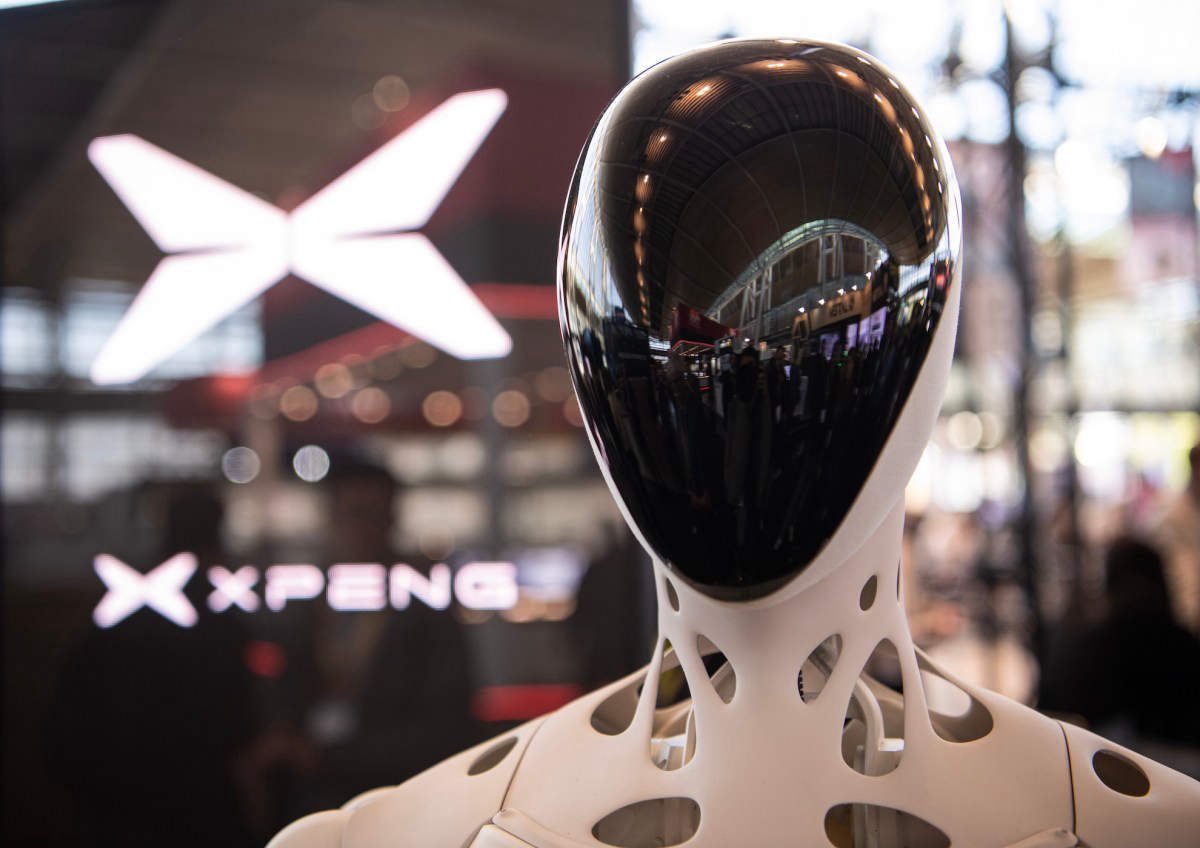
Earlier this week, Xpeng’s robotics arm pulled in upwards of $900 million at a post-money valuation north of $6.3 billion. Meanwhile, the carmaker behind it faces margins that everyone across China’s auto sector can watch getting thinner.
Most of what is unfolding right now comes down to that gap.
“He sees razor-thin profit in cars on the near horizon. Robots look much more promising,” said Michael Dunne, CEO of Dunne Insights, an advisory firm based in San Diego and Singapore, referring to Xpeng founder He Xiaopeng.
The funding round is the tell
The round was led by IDG Capital, joined by Gaorong Ventures, Tencent and Alibaba. According to Xpeng, it stands as the biggest single-round private financing ever logged in China’s “embodied AI” sector — that is, AI systems wired directly into physical machines.
Reports indicate that He Xiaopeng and Xpeng co-president Brian Gu contributed around $100 million from their own pockets. When founders cut personal checks into a subsidiary they already control, the message lands harder than any pitch deck.
The product carries the name Iron, a humanoid with a realistic human shape engineered for commercial rollout. It is not a research platform. It is not a stage demo.
Everyone else piled in this month
Chery Automobile’s robotics division, AiMOGA, has reportedly started laying groundwork for an IPO. BYD showed off a humanoid named Xiao Di. Changan, GAC, Li Auto, SAIC and Seres each have humanoid programs underway.
Among that crowd, Dunne points to a single firm as the one genuinely running Tesla’s playbook. “It’s the most focused on autonomy, it’s the first to commit in a big way to humanoid robots,” he said of Xpeng, characterizing He Xiaopeng as a tech billionaire known for his agility and quick adjustments.
Hardware is the easy half
Automakers already own the factories and supply chains, and they can turn out thousands of identical actuators without going broke doing it. Against a robotics startup buying time on somebody else’s production line, that counts for a lot.
Dunne, for his part, doesn’t think it decides the contest. “They have all the hardware to get the job done,” he said. “Question is if they can catch Tesla on the AI side if the equation.”
None of the hype is fresh — Elon Musk and Optimus handled that, as did years of Boston Dynamics Atlas clips. The shift sits underneath: robot bodies keep getting better, and researchers have come around to the view that the AI techniques behind large language models could give complex robots the ability to learn nearly any task. It is that conviction the $6.3 billion is priced against.
The one company with a delivery date
Agility Robotics, Apptronik and Figure are pursuing the same goal of commercial deployment at scale. Boston Dynamics, owned by Hyundai, has come nearest.
Hyundai intends to bring Atlas into its Georgia plant this year, with the robots eventually handling jobs such as parts sequencing by 2028. To accelerate work on Atlas, the automaker teamed up with DeepMind, Google’s AI research lab, and this year it is opening a U.S. site called a Robot Metaplant Application Center where robots will learn to map movements like lifts and turns.
The supplier tier is in motion as well. Mobileye acquired humanoid startup Mentee Robotics earlier this year for $900 million — about the sum Xpeng just raised for its whole robotics unit. Rivian is testing the waters via its Mind Robotics spinout, though its machines aren’t expected to resemble the humanoids the rest of the field is building.
Keep an eye on that 2028 parts sequencing goal. Across this entire field it is the only public commitment attached to a specific factory, a specific job and a specific year — and it is the benchmark the Chinese entrants will be judged by, like it or not.