


Strategy has attached a figure to the downside, and that figure is $13,400. The company is marketing it as the “BTC Floor” for STRC, its variable-rate cumulative perpetual preferred stock. Bitcoin trades near $78,000, so the label reads like an enormous cushion.
Read the SEC-filed briefing and it describes something far narrower. The floor is nothing more than the Bitcoin price at which Strategy’s illustrative STRC coverage ratio would hit 1.0x. Nothing beyond that.
It hands you no claim on Strategy’s Bitcoin. It says nothing about solvency, and nothing about what you would recover if things went badly.
The math is a division problem, not a promise
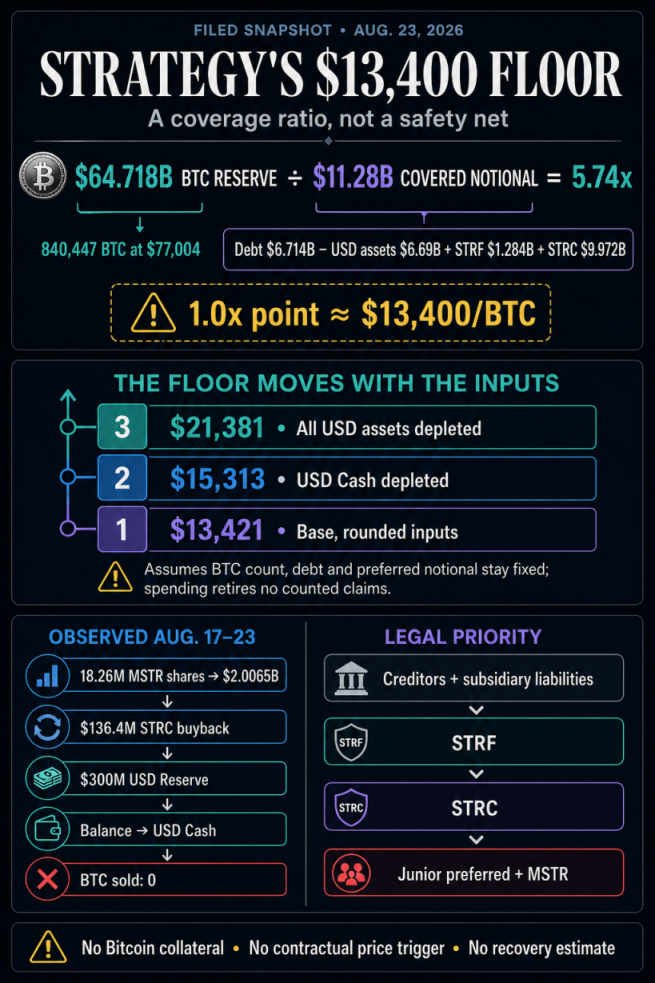
The BTC Rating divides the dollar value of Strategy’s Bitcoin reserve by a covered-notional denominator. The floor simply reverses that arithmetic: covered notional divided by the number of Bitcoin held.
Which means spot Bitcoin moves the displayed rating and nothing else. Freeze every company input and the 1.0x price refuses to budge.
Here is the denominator, assembled from the filing. Begin with $6.714 billion of debt. Take out $6.69 billion of USD assets. Add $1.284 billion of senior STRF plus $9.972 billion of STRC. You land around $11.28 billion.
At the dashboard’s $77,004 price, Strategy’s 840,447 Bitcoin were worth $64.718 billion. That works out to 5.74x, shown as 5.7x.
Unrounded, the company puts the floor at $13,415. Run it with the rounded denominator and Bitcoin count instead and you get about $13,421. Both end up described as roughly $13,400.
I pulled the live number during an Aug. 30 research pass, with Bitcoin market data at $78,440.50. Hold the dated company inputs fixed and the rating climbs to about 5.84x. The floor stays near $13,421. The headline figure moved by nothing.
Spending cash raises the floor, and that part gets skipped
The threshold isn’t fixed. USD assets shift it, and they shift it in the direction holders won’t like.
Drain the $1.59 billion USD Cash pool without cutting debt or preferred notional and the modeled point lifts to about $15,313. Drain all $6.69 billion of USD assets on uses that retired no counted claims and it pushes toward $21,381.
Each of those sensitivities holds every other input constant. Still, they show the floor is a function of choices Strategy makes, not a property of the Bitcoin sitting on its balance sheet.
What the company actually did last week
Managing stress starts long before anyone reaches a courtroom. Over the latest disclosed week, Strategy sold 18,261,118 MSTR shares for $2.0065 billion.
Of that, $136.4 million went to buying back 1,431,212 STRC shares. Another $300 million was added to the USD Reserve, with the rest dropped into USD Cash. It sold no Bitcoin.
Common issuance supplied the funding. So the immediate bill landed on MSTR holders in the form of dilution. That is the real mechanism here, and it fires nowhere near $13,400.
None of the cash is pledged to you
Strategy still had $516.6 million of preferred repurchase authority left and $1 billion for MSTR. Neither program requires a single purchase.
Board policy designates the $5.10 billion USD Reserve for preferred dividends and debt interest. Board policy, not a lien. USD Cash can go toward Bitcoin purchases, repurchases, note repayment or reserve growth, whichever management prefers.
Neither pool is pledged to STRC.
The order of losses
STRC cash dividends depend on declaration and legally available funds. A missed installment accumulates and compounds, which sounds protective until you notice what it doesn’t do: force a payment.
Both the market price and the cash timing can deteriorate well before the modeled ratio ever touches 1.0x.
In an actual restructuring the queue is explicit. Creditors, subsidiary liabilities and STRF rank ahead of STRC. Junior preferred and MSTR common rank behind it. STRC sits in the middle, and the middle is where dated illustrations stop helping.
The $13,400 figure maps one dated set of assets and counted claims, and it does that honestly. It just isn’t the thing that will hurt first.
The earlier pressure points are capital-market access, available cash and discretionary allocation decisions. Each one can shift cost among MSTR holders, STRC holders and the Bitcoin reserve, and each one is already live. Bitcoin is +0.41% over the past 24 hours and currently sits at rank #1 by market cap, which is exactly as relevant to your STRC position as the floor is.