

In Brief:
- The Sandbox (official site) has put almost three years into Sandbox Studio, an AI toolset for professional developers, according to CEO Robby Yung. A public launch is provisionally planned for October.
- Rather than generating games from prompts, the tools are meant to automate debugging, testing, content updates and porting.
- The approach departs from the no-code Game Maker, which Yung said acted as a constraint on real game developers.
AI now sits at the centre of The Sandbox’s rebuilt creation tools, and hobbyists are not the main audience. According to CEO Robby Yung, the new Sandbox Studio is aimed mainly at developers who already use engines such as Unity and Unreal.
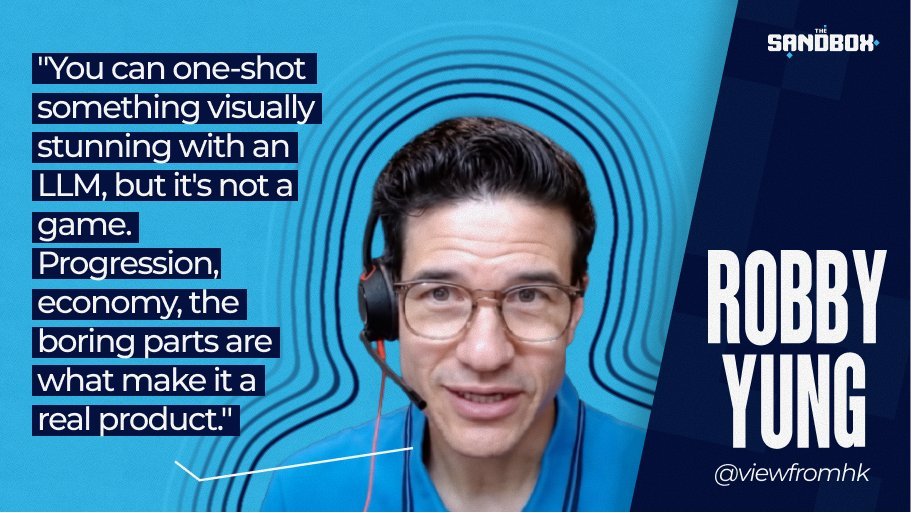
Speaking on episode #213 of the Blockchain Gaming World podcast series, Yung was blunt: “The goal here is not to automate game creation. Because that’s how you get AI slop.”
An LLM can create a demo that looks incredible. But it’s not a game: progression, monetization, multiplayer… the boring parts are what make it a real product.
Watch the full conversation with @viewfromhk CEO of The Sandbox, and @blockchaingmgThe SandboxView on X ↗
On X, The Sandbox made the same case in different terms: “An LLM can create a demo that looks incredible. But it’s not a game: progression, monetization, multiplayer… the boring parts are what make it a real product.”
An October launch after nearly three years of work
Sandbox Studio has been in development for almost three years, Yung said. The company has tested it through a series of controlled game jams and has provisionally scheduled the public launch for October.
The focus is the repetitive side of production: debugging, testing and content updates, and above all porting one title to several platforms.
Under the current plan, creators can export their projects to the web, Telegram, mobile app stores and Steam. Yung argues that releasing on several platforms can multiply what a single game earns.
Moving past Game Maker
The change takes the company away from the no-code tools it started with. VoxEdit and Game Maker opened up game building to more people, but their simplicity limited what professional studios could produce.
“If you were an actual game developer, then those tools actually acted as a constraint,” Yung said.
It also leaves behind the founding idea that creators would build games mostly for The Sandbox's own virtual world. The interview also took up whether The Sandbox can hold on to its brand if it drops its voxel art style.
Leaner teams
Yung expects the tools to let studios run with far fewer staff. Citing a conversation with Hilmar Veigar Pétursson, CEO of Fenris Creations, he suggested that even serious game studios may soon have no reason to employ more than 30 people.
At the other end of the scale, he said teams of one or two people will use AI to make games that once required much larger organizations.
The episode also covered Yung’s view of the past 12 months in blockchain games and how AI adoption is changing both development and distribution.
Background
The rebuild follows a management reorganization at The Sandbox in the summer of 2025.
In September 2025, Yung published a vision statement that placed the company where AI, Web3 and mobile meet. At the time, the company said it had more than 400 major brand partners, over 400,000 creators and more than 8 million users.
According to that statement, The Sandbox had started training custom AI models for asset generation using a library of 1.7 million assets and hundreds of game templates. It also announced a partnership with Rosebud AI.
Yung said then that “the biggest challenge for creators very often occurs post-creation in the form of distribution, engagement, and monetization.” The first investment aimed at that problem was SANDchain, a cross-platform layer that The SANDChain Foundation built with support from The Sandbox.
“We have made significant progress in addressing this via our no-code creation tools (VoxEdit, Game Maker), but AI will revolutionize this space and we plan to lead the charge,” Yung said in that statement.