

A painting sitting in the background of a 2003 Star Trek episode depicts a vessel hardly anyone discusses. A long tubular hull. Massive rings circling it. That’s the USS Enterprise XCV 330, glimpsed in Star Trek: Enterprise season 2, episode 24, “First Flight,” and then more or less left behind by canon.
Discounting the real orbiter NASA rolled out in 1977, it’s the earliest known space-faring ship to carry the name. Even measured against Enterprise-era hardware its design was primitive, and virtually nothing about its specifications or history has been revealed since.
Which is an appropriate place to begin, because the Enterprise was never a single ship. The name keeps getting handed to whatever the fleet’s newest and best happens to be, and its shape has been argued over, stretched, flattened and rebuilt across six decades.
The saucer and the nacelles remain. Everything else is negotiable.
The vessel that made the Federation possible
The Enterprise NX-01 launched in 2150 under Captain Jonathan Archer (Scott Bakula), who kept the chair until 2161. It’s the setting for Star Trek: Enterprise, and it looks like nothing that came after: an enormous saucer narrowing into two nacelles set in line with it, giving the whole thing a sleeker profile than any later Enterprise managed.

It was the first Earth starship able to reach Warp 5. That counted for more than any weapon it carried, because the alliances Archer built aboard it are what created the United Federation of Planets.
Then the Federation scrapped it. The NX-01 was scuttled once Vulcan technology had left it embarrassingly outclassed, and the name went dormant.
Pike’s Enterprise and Kirk’s aren’t quite the same ship
The Constitution Class brought the name back. The USS Enterprise NCC-1701 launched in 2245 under Captain Robert April (Adrian Holmes), with Commander Christopher Pike serving as his Number One. Five years later Pike took command and ran the Federation flagship for almost 15 years.

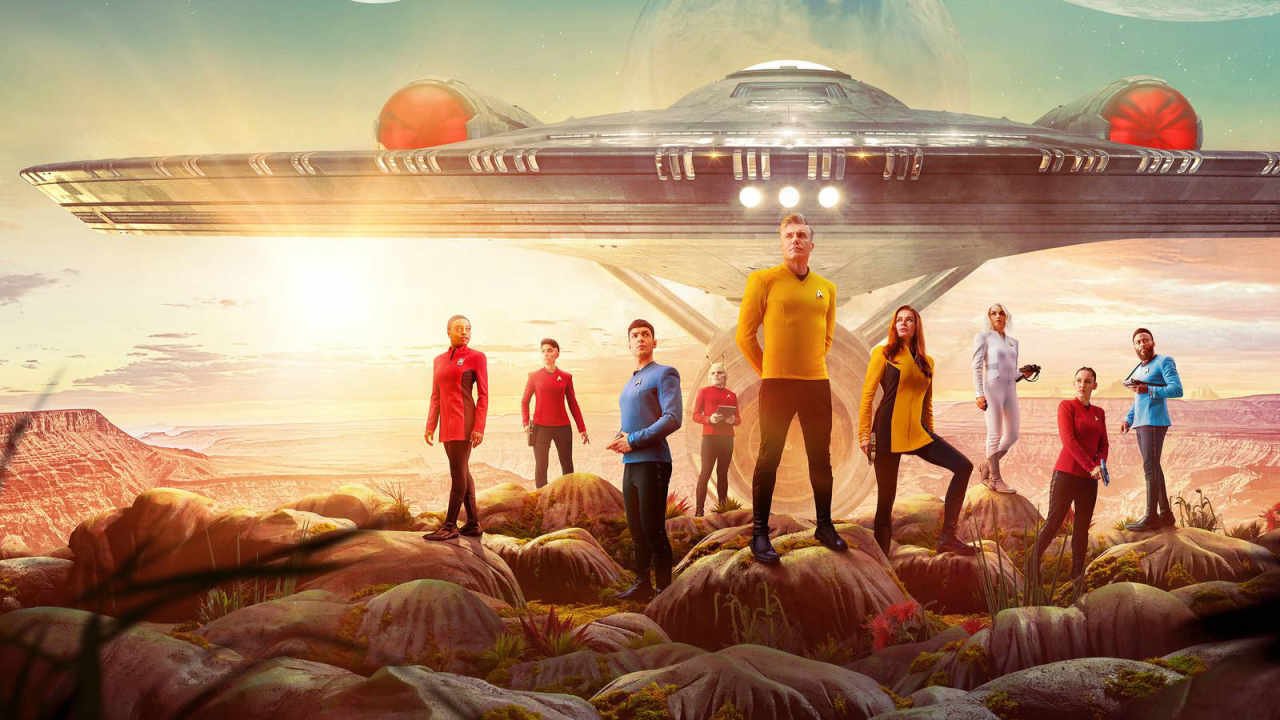
Star Trek: Strange New Worlds follows Pike’s (Anson Mount) last five-year mission before he passes the chair to James T. Kirk (William Shatner). Because television production has changed, his ship carries small differences from the one seen in Star Trek: The Original Series. The nacelles glow a more vibrant red. The exterior is better lit.

It’s also been pointed out that Pike’s Enterprise is bigger than Kirk’s, which implies a refit somewhere in the gap between the two shows.
Four decades of service, then a blaze of glory
The two five-year missions Kirk ran between 2265 and 2280 are the ones Starfleet still tells stories about. Romulans, Klingons and more strange stellar phenomena than any log could hold — and 20 years after launch, the ship showed no signs of its age.
The season 1 finale of Strange New Worlds went further still, confirming that without Kirk the Federation would have ended up in a brutal war with the Romulan Star Empire.
Two other men captained the NCC-1701 after him: Captain Willard Decker (Stephen Collins) and Captain Spock (Leonard Nimoy).
The ship itself was far larger than the NX-01, with a secondary hull slung beneath the saucer that made it noticeably less aerodynamic. Refits kept updating it, and by Star Trek: The Motion Picture the interior had been rebuilt entirely. Then Admiral Kirk blew it up himself in Star Trek III: The Search for Spock, ending 40 years of service.
The replacement that never worked right
Kirk was demoted back to Captain over that and handed a new ship anyway. The NCC-1701-A was commissioned in 2286, nearly a twin to its predecessor in appearance and technical specifications, and it did not function properly. Star Trek V: The Final Frontier is largely a document of its technical problems.
Across the Enterprise-A’s seven-year service period, Kirk was the only person ever to captain it. It was decommissioned in 2293 after Star Trek VI: The Undiscovered Country, and Star Trek: Picard season 3 revealed it as an exhibit at the Fleet Museum on Anthan Prime in the early 25th century.
One flight for the B, and Kirk was gone
The Excelsior Class turned up in The Search for Spock and made the Constitution Class look like a Starfleet dinosaur overnight. In Star Trek Generations, the Excelsior Class USS Enterprise NCC-1701-B launched in 2293 with Captain John Harriman (Alan Ruck) in command.
A flattened saucer. No neck joining the hulls. Kirk apparently died on its first flight, and everything the B did afterward survives only in non-canon stories — a strange fate for a ship whose 36-year service period nearly beat the original’s.
A single episode, and it still matters more than most
The USS Enterprise NCC-1701-C turns up in precisely one hour of television: Star Trek: The Next Generation, season 3, episode 15, “Yesterday’s Enterprise.” It was destroyed in 2344 defending the Klingon outpost Narendra III from a Romulan attack, and that death is what let the Federation forge its alliance with the Klingons.
The Ambassador Class design threw out the B’s streamlining in favour of a longer neck and a tubular secondary hull that called back to older ships. Captain Rachel Garrett (Tricia O’Neil) commanded it, and she remained the only woman to captain an Enterprise until Seven of Nine (Jeri Ryan) took the Enterprise-G in the Picard season 3 finale.
The largest one ever built
The USS Enterprise 1701-D joined Starfleet as the biggest vessel ever to carry the name, dwarfing the classic NCC-1701. Commissioned in 2363, the Galaxy Class flagship spent eight years in deep space under Captain Jean-Luc Picard (Patrick Stewart), and its technology was good enough that the ship reads as a TNG character in its own right.
Its oval, removable saucer was a sharp break from the circles that came before it, and the secondary hull went wide and flat instead of tubular.
Star Trek Generations destroyed it. Even so, that sub-decade tenure packed in more consequential events than several earlier Enterprises put together, and Commodore Geordi La Forge (LeVar Burton) lovingly restored the D so it could save the galaxy one more time in Picard season 3 before it took its place at the Fleet Museum.
Picard’s second command went to war
Ship classes once lasted generations. After TNG, Starfleet began turning them over every few years.
The Sovereign class USS Enterprise NCC-1701-E was commissioned under Picard in 2372 to replace the D. Sent back in time to fight the Borg in Star Trek: First Contact, it minimized the lower hull and pulled the nacelles in line with the saucer for a narrow body that suited the more warlike tone of post-TNG Trek.
It largely sat out Deep Space Nine’s Dominion War, and Jean-Luc says out loud in Star Trek: Insurrection how much that frustrates him. The Enterprise did brush the edges of the conflict in that film by confronting the So’na, who manufacture the ketracel white used to control the Jem’Hadar.
Picard left the E to lead a rescue armada evacuating Romulus during the supernova. Captain Worf (Michael Dorn) succeeded him. What became of the ship under Worf is still a mystery.
The one that began in a video game
The Odyssey Class USS Enterprise NCC-1701-F launched in 2386 and was slated for early decommissioning as part of Starfleet’s Frontier Day celebrations in 2401. Beyond the fact that several captains commanded it over 15 years, the record is thin.
Here’s the odd part: the F originated in the Star Trek Online video game, and Picard season 3 production designer Dave Blass made it canon.
Admiral Elizabeth Shelby (Elizabeth Dennehy) led its final ceremonial flight on Frontier Day 2401, before her death at the hands of the Borg. Once Picard and the restored Enterprise-D crew destroyed the Borg signal and cut the connection to the assimilated fleet, the F likely wound up in storage at the Fleet Museum.
Back to the beginning, more or less
Picard season 3 closed the loop by returning the Enterprise to Constitution Class status. The Constitution III Class — also called the Neo-Constitution Class — USS Enterprise NCC-1701-G launched in 2402 after an extensive refit that turned the USS Titan-A into an Enterprise, carried out in recognition of Admiral Picard and the crew’s actions during the Borg and Changeling attack in the show’s final episodes.
Seven of Nine holds the chair. Commander Raffi Musiker (Michelle Hurd) is her First Officer. And the Ensign standing behind them is Jack Crusher (Ed Speleers), son of Jean-Luc Picard.
With a crew like that, the name stays attached to diplomacy, heroism and exploration for a long time yet.